 (918) 694-1483
 3-Tab vs. Architectural Shingles: Which Is Actually Best for Tulsa Roofs?
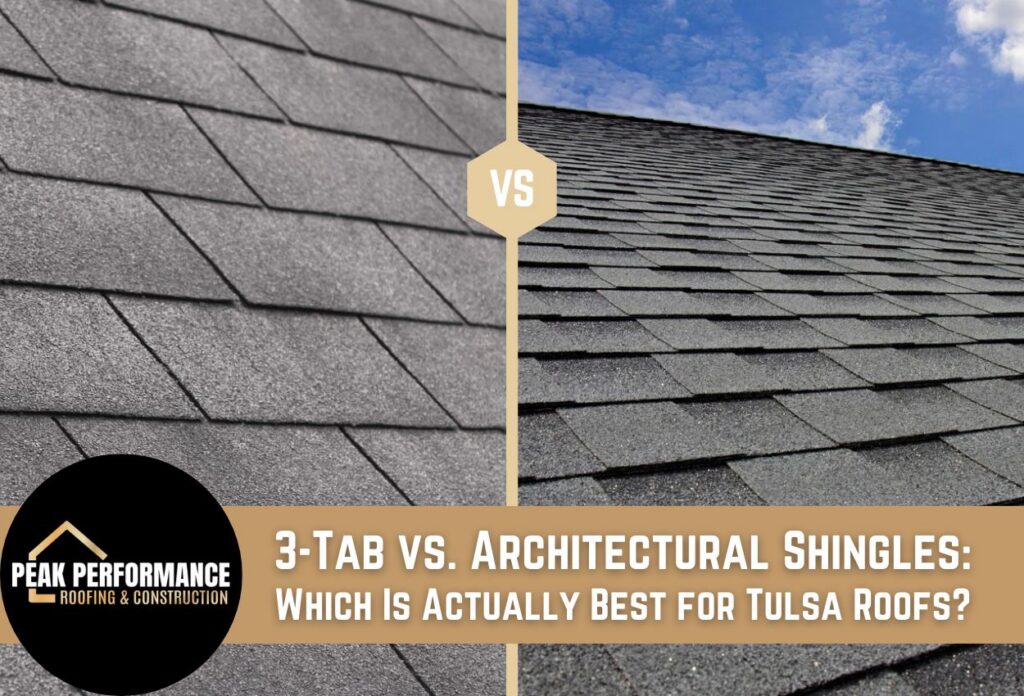

For most Tulsa homeowners, architectural shingles are the better choice. The city averages 50+ severe weather days per year and sits within one of Oklahoma’s highest hail-frequency corridors, making a stronger shingle more than a preference.
3-tab shingles are single-layer asphalt shingles rated to withstand winds of 60 to 70 mph. Architectural shingles are laminated, multi-layer shingles rated to 110 to 130 mph wind resistance. That gap matters in a region where straight-line winds and tornado-producing storms are a regular seasonal threat.
This article breaks down the cost difference between the two shingle types, the lifespan gap homeowners should know before buying, how each performs against Tulsa’s wind and hail exposure, and a straightforward decision framework to help homeowners choose the right option for their roof.
*Please note, price ranges listed in this article may not reflect the final cost of your project. Prices are subject to change based on various factors such as local labor rates, material quality, and more. All costs established in this article are rough estimates based on average industry rates.
How Do 3-Tab and Architectural Shingles Actually Differ in Durability for Oklahoma Weather?
Architectural shingles outperform 3-tab shingles in every durability category that matters for Tulsa’s hazard profile. Wind resistance, hail impact, lifespan, granule retention, and weight all favor the laminated option.
| Performance Category | 3-Tab Shingles | Architectural Shingles |
|---|---|---|
| Wind Resistance Rating | 60 to 70 mph | 110 to 130 mph |
| Hail Impact Rating | Class 1 | Class 3 to 4 available |
| Expected Lifespan in Oklahoma Climate | 15 to 20 years | 25 to 30 years |
| Granule Retention Under UV and Heat Cycling | Poor loses 3 to 5 years vs. the manufacturer’s estimate | A better, heavier mat holds granules longer |
| Weight per Square (100 sq. ft.) | 150 to 240 lbs | 240 to 400 lbs |
Northeastern Oklahoma averages 5 to 7 significant hailstorms per year, and straight-line winds of 60 to 80 mph occur regularly during spring storm season, meaning a 3-tab shingle rated at 60 to 70 mph is already at its limit before a severe storm even peaks. Tulsa’s summer highs of 90 to 95 degrees combined with winter lows of 25 to 35 degrees create repeated temperature swings that accelerate granule loss on lighter 3-tab shingles, cutting effective lifespan by 3 to 5 years compared to what manufacturers estimate in milder climates. That lifespan gap of 15 to 20 years for 3-tab versus 25 to 30 years for architectural is the most important number Tulsa homeowners should factor into any roofing decision.
What Is the Real Cost Difference Between 3-Tab and Architectural Shingles in Tulsa?
Architectural shingles cost roughly $500 to $1,200 more than 3-tab shingles on a standard Tulsa single-family roof, a modest upfront gap when measured against a lifespan difference of 15 to 20 years versus 25 to 30 years.
| Cost Category | 3-Tab Shingles | Architectural Shingles |
|---|---|---|
| Material Cost per Square (100 sq. ft.) | $80 to $100 | $100 to $130 |
| Installed Cost per Square (labor + materials) | $150 to $200 | $180 to $240 |
| Average Total Cost 1,500 sq. ft. Tulsa Roof | $2,250 to $3,000 | $2,700 to $3,600 |
| Tulsa Permit Fees (both types) | $75 to $150 | $75 to $150 |
| Manufacturer Warranty Length | 20 to 25 years | 30 years to a limited lifetime |
Permit fees in Tulsa typically add $75 to $150 to any roofing project, regardless of shingle type, so that cost is a wash. The bigger factor many homeowners miss is insurance. Many Tulsa insurance carriers now charge higher premiums or apply reduced claim payouts on roofs with 3-tab shingles older than 15 years, which means the true cost of choosing 3-tab extends well past installation day. When insurance costs and the shorter 15 to 20-year lifespan are factored in, the $500 to $1,200 upfront savings on 3-tab shingles can disappear fast on a Tulsa roof.
Do Architectural Shingles Hold Up Better Against Tulsa Hail Storms?
Yes, and the impact resistance rating system explains exactly why. The UL 2218 scale rates shingles from Class 1 (weakest) to Class 4 (strongest) based on how well they withstand a steel ball dropped to simulate hail. Most 3-tab shingles are manufactured at Class 1 to 2. Architectural shingles are far more commonly available in Class 3 to 4 ratings, which matters in a region where hail damage roof repair is a recurring seasonal reality.
Insurance Savings From Class 4 Shingles
Class 4 impact-resistant shingles can qualify Tulsa homeowners for insurance discounts of 15% to 30% with some Oklahoma carriers. That discount alone can offset a meaningful portion of the upgrade cost over several years of ownership.
How 3-Tab Shingles Hold Up Over Time in Oklahoma Weather
Field observations by Tulsa roofing contractors show that 3-tab roofs installed in the 1990s and 2000s routinely reached end-of-life at 15 to 18 years, well short of the 20-year manufacturer estimate due to cumulative hail granule loss and thermal stress from the region’s temperature swings. After a significant hailstorm with stones 1 inch in diameter or larger, 3-tab shingles typically show visible bruising and granule displacement that requires partial or full residential roof replacement. Class 4 architectural shingles often pass post-storm inspection with no functional damage, reducing total storm-related replacement frequency over a 30-year ownership period. That difference in replacement frequency adds up to real savings for Tulsa homeowners who stay in their homes long term.
Are Architectural Shingles Worth the Extra Cost for Tulsa Homeowners?
For any Tulsa homeowner planning to stay in the home 7 or more years, the math favors architectural shingles. The $500 to $1,200 upfront premium spread across a 10-year lifespan difference works out to just $50 to $120 per year, an amount many homeowners recover through insurance discounts alone.
- Planning to own the home 7+ years: The cost-per-year advantage of architectural shingles becomes measurable at the 7-year mark. A $50 to $120 annual cost difference is easily offset by the 15% to 30% insurance discounts available to Tulsa homeowners who install Class 4 impact-resistant shingles.
- Low-to-moderate roof slope: Many Tulsa homes feature low-to-moderate pitch roofs where wind uplift risk is higher. Architectural shingles rated to 110 to 130 mph provide a clear safety margin over 3-tab shingles rated to only 60 to 70 mph.
- Open-terrain neighborhood with hail exposure: Homes in open areas with fewer wind breaks face greater hail and wind impact. Class 3 to 4 architectural shingles are built to handle the 1-inch-plus hailstorms that Tulsa sees 5 to 7 times per year.
- Bundling a roof replacement with a home sale: A newer architectural shingle roof can support appraisal value and give buyers confidence, especially compared to aging 3-tab shingles that inspectors flag for shortened remaining lifespan.
- Budget ceiling under $6,000 total: If the total roofing budget cannot stretch beyond $6,000, 3-tab shingles may be the only realistic option for a full replacement on a larger roof.
- Short-term ownership of 5 years or less: Homeowners planning to sell within 5 years may not benefit enough from the longer 25 to 30 year lifespan of architectural shingles to justify the higher upfront cost.
For most Tulsa homeowners, the $50 to $120 annual cost difference between the two shingle types is the deciding factor, and in most cases, that gap closes quickly once insurance savings and reduced replacement frequency are factored in.
What Is the Long-Term ROI of Choosing Architectural Shingles on a Tulsa Roof?
On a typical Tulsa home, architectural shingles deliver $3,000 to $6,000 in net 30-year savings compared to repeated 3-tab replacement cycles, even before accounting for reduced storm damage claim frequency. The table below shows why that number holds up under a straightforward side-by-side comparison.
| ROI Factor (30-Year Period) | 3-Tab Shingles | Architectural Shingles |
|---|---|---|
| Replacements Needed Over 30 Years | 2 replacements | 1 replacement |
| Total Estimated Replacement Cost | About $14,000 (2 × About $7,000) | About $9,500 (1 × About $9,500) |
| Insurance Premium Savings (Class 4) | None | $1,800 to $4,500 over 30 years |
| Net 30-Year Cost | About $14,000 | About $5,000 to $7,700 |
The 15 to 20-year lifespan of 3-tab shingles forces most Tulsa homeowners into a second full replacement within a 30-year window. Architectural shingles, with a 25 to 30 year lifespan, typically require only one. That extra replacement alone adds roughly $7,000 in costs before insurance savings are even considered.
Resale value adds another layer to this calculation. Buyers and appraisers in Tulsa’s market assign higher value to roofs with 20 or more years of warranty life remaining. A recently installed architectural roof can add $5,000 to $8,000 in perceived home value at the point of sale compared to an aging 3-tab roof with under 5 years of estimated life remaining. When replacement costs, insurance savings, and resale value are all factored together, architectural shingles are the stronger financial choice for most Tulsa homeowners who plan to own their home beyond the 7-year mark. Peak Performance Roofing & Construction can walk through a residential roof inspection tailored to a specific home’s square footage and current roof condition.
Ready to Replace Your Tulsa Roof? Here’s How to Get the Right Shingles Installed Correctly.
The $3,000 to $6,000 in net 30-year savings shown earlier only come through if the right shingles are installed the first time correctly. Peak Performance Roofing & Construction serves Tulsa homeowners with free inspections and written quotes, asking specifically about Class 3 or Class 4 impact-rated asphalt shingles and whether your carrier qualifies for insurance discount documentation.
For most Tulsa homes, the upgrade to architectural shingles pays for itself, and a qualified local contractor can confirm the right wind and impact rating for your specific neighborhood and roof geometry.
Schedule your free roof inspection.
Not ready to schedule? Learn more about shingle roof installation.